
‘Thus religions are preached and are forgotten, empires rise and fall, philosophies are born and die, art and poetry bloom and fade, as societies pass from the disintegration wherein the imagination kindles, to the consolidation whose pressure ends in death.’
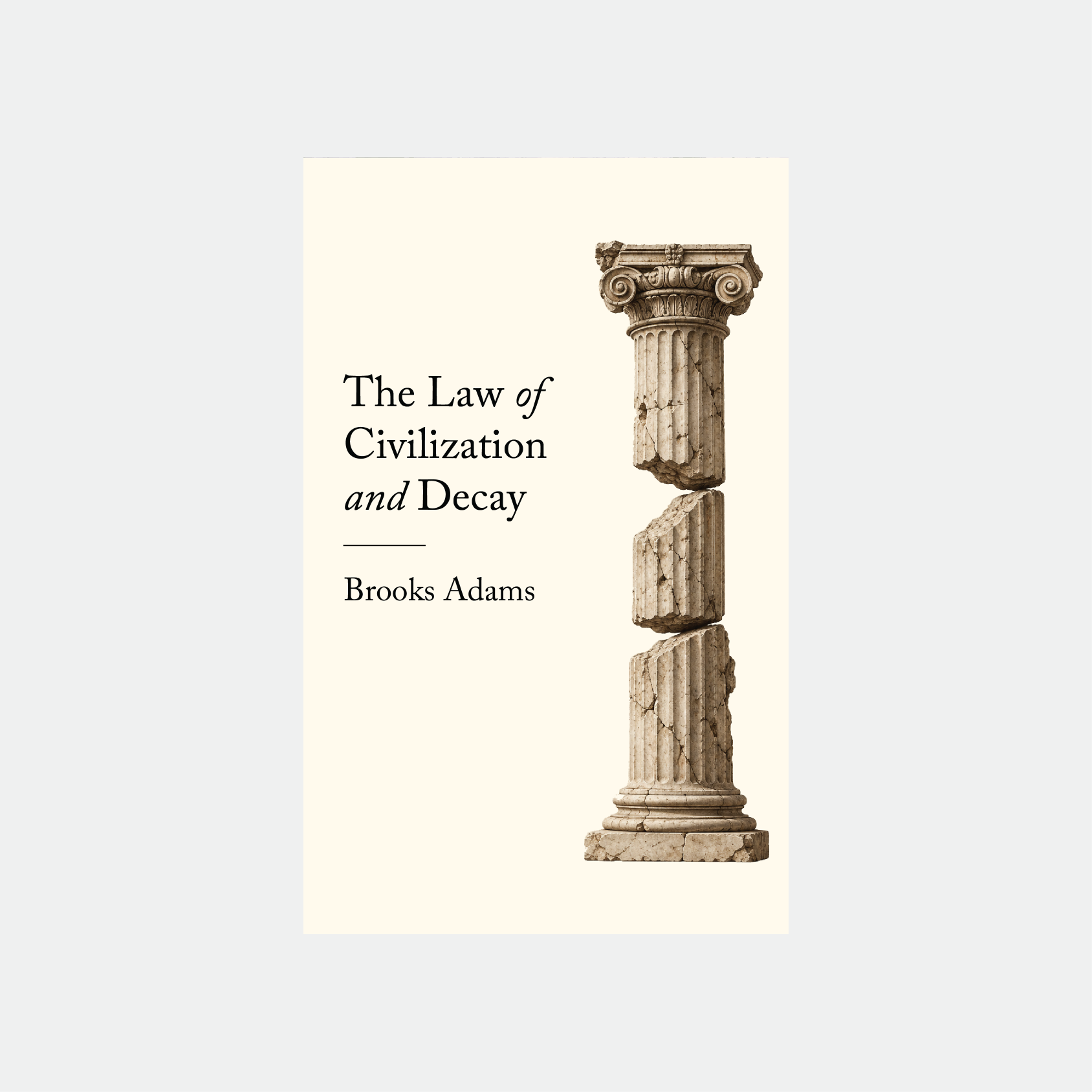
The Law of Civilization and Decay is Brooks Adams’s provocative attempt to understand the fundamental laws that shape the rise and decline of civilizations. According to Adams, civilizations rise and fall in predictable cycles driven by social and economic forces. As society develops and industrializes, it also becomes an increasingly centralized, commercial, and bureaucratic system, and the decentralized and imaginative forces that originally drove development give way to these centralizing forces. Imaginative energy gives way to capital accumulation, and the change in the focus of society alters human temperament. For Adams, this change is what eventually leads to the decay of civilization. From the Roman Empire to the nineteenth-century European empires, Adams studies multiple empires throughout history in order to distill the laws of civilization, which he considers to be as inevitable as natural selection. Ambitious and striking in its interpretation of history, The Law of Civilization and Decay remains a classic of social theory to this day.
Brooks Adams was an American historian and political scientist. He had a wide range of academic interests, ranging from geopolitics and finance to the rise and decay of civilizations.